Private Limited Company Registration Guide AY 2025-26 & FY 2026-27
Introduction
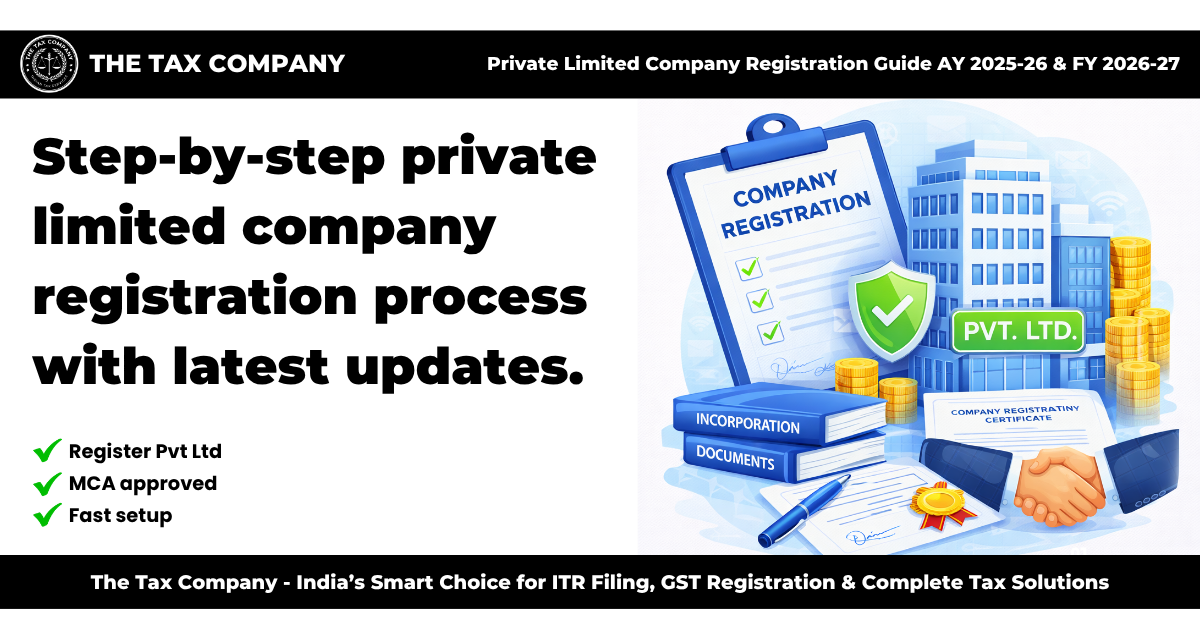
A Private Limited Company is one of the most popular business structures in India due to its separate legal identity, limited liability, and ease of raising funds. It is widely preferred by startups, growing businesses, and entrepreneurs aiming for scalability and credibility.
For Assessment Year (AY) 2025-26 and Financial Year (FY) 2026-27, registering a private limited company provides a strong legal foundation and access to various business opportunities.
This guide provides a complete overview of private limited company registration.
What is a Private Limited Company?
A Private Limited Company is a business entity registered under the Companies Act, 2013, with a separate legal identity from its owners.
It limits the liability of shareholders to their shareholding and allows the company to own assets, enter contracts, and operate independently.
Key Features of a Private Limited Company
- Separate legal entity
- Limited liability of shareholders
- Perpetual succession
- Ability to raise funds
- Restricted transfer of shares
Eligibility Criteria for Registration
To register a private limited company:
- Minimum 2 directors required
- Minimum 2 shareholders required
- At least one director must be a resident of India
- Unique company name required
Benefits of Private Limited Company
- Limited liability protection
- Easy access to funding and investors
- Enhanced business credibility
- Separate legal identity
- Continuity of business
Documents Required for Registration
The following documents are generally required:
- PAN card of directors and shareholders
- Aadhaar card or identity proof
- Address proof of directors
- Passport-sized photographs
- Address proof of registered office
- No Objection Certificate (NOC) from property owner
- Digital Signature Certificate (DSC)
Step-by-Step Registration Process
Step 1: Obtain Digital Signature Certificate (DSC)
- Required for online filing
Step 2: Apply for Director Identification Number (DIN)
- Obtain DIN for directors
Step 3: Reserve Company Name
- Apply through MCA portal
Step 4: Prepare Incorporation Documents
- Draft Memorandum of Association (MOA) and Articles of Association (AOA)
Step 5: File SPICe+ Form
- Submit incorporation application
Step 6: Certificate of Incorporation
- Issued upon approval
Post-Registration Requirements
After incorporation, the company must:
- Open a business bank account
- Apply for PAN and TAN
- Register for GST (if applicable)
- Maintain statutory records
- Appoint auditor
Compliance Requirements
- Filing annual returns
- Conducting board meetings
- Maintaining books of accounts
- Filing income tax returns
- ROC compliance
Common Mistakes to Avoid
- Choosing a non-compliant company name
- Incomplete or incorrect documentation
- Not fulfilling compliance requirements
- Ignoring post-registration formalities
Tips for Smooth Registration
- Choose a unique and compliant name
- Ensure accurate documentation
- Follow MCA guidelines carefully
- Complete post-registration formalities promptly
Role of Professional Assistance
Professional assistance can help:
- Ensure accurate registration
- Handle documentation and filing
- Avoid delays and rejection
- Provide compliance support
Conclusion
Private Limited Company is an ideal structure for businesses looking for growth, credibility, and limited liability protection. Proper registration and compliance ensure long-term success and scalability.
For AY 2025-26 and FY 2026-27, entrepreneurs should consider this structure for building a strong and legally compliant business.
Need Help with Private Limited Company Registration?
The Tax Company (TTC) provides expert assistance in company registration and compliance. Our team ensures smooth incorporation and complete support.
Contact us today for professional assistance.