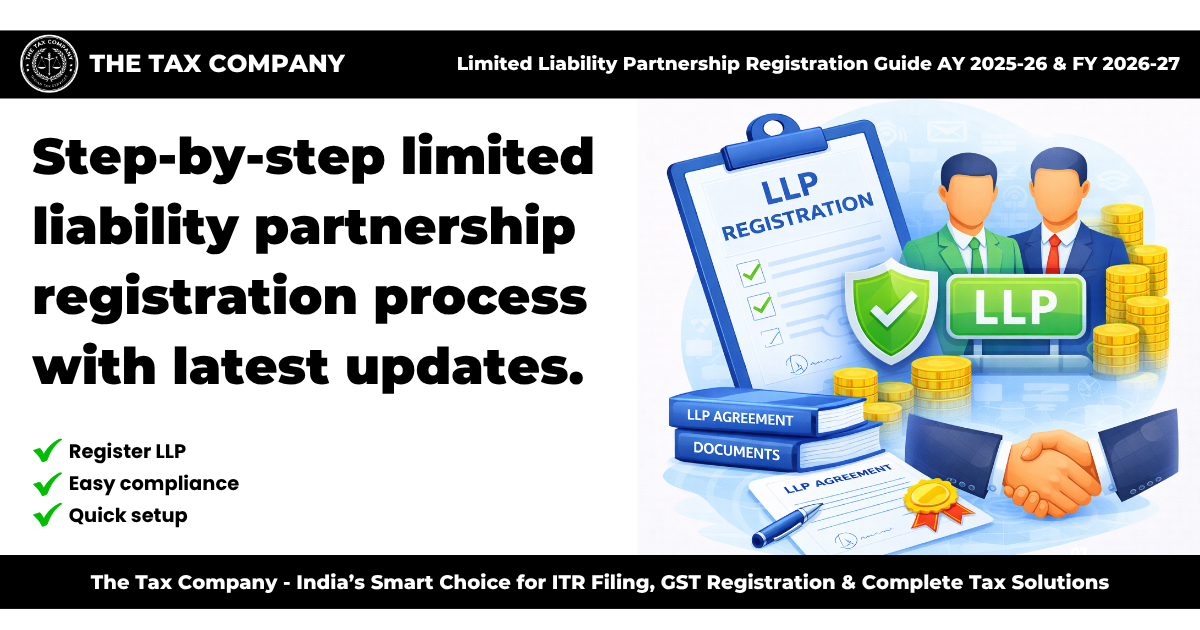
Limited Liability Partnership (LLP) Registration Guide AY 2025-26 & FY 2026-27
Introduction
A Limited Liability Partnership (LLP) is a popular business structure that combines the flexibility of a partnership with the advantages of limited liability. It is widely preferred by professionals, startups, and small businesses due to its ease of management and reduced compliance requirements compared to companies.
For Assessment Year (AY) 2025-26 and Financial Year (FY) 2026-27, LLP registration offers a structured and legally recognized way to run a business with shared ownership.
This guide provides a complete overview of LLP registration in India.
What is a Limited Liability Partnership (LLP)?
An LLP is a separate legal entity formed under the Limited Liability Partnership Act, 2008. It allows partners to manage the business while limiting their liability to the extent of their agreed contribution.
It combines features of both partnership firms and companies.
Key Features of LLP
- Separate legal entity
- Limited liability for partners
- Perpetual succession
- Flexible management structure
- No minimum capital requirement
Who Can Form an LLP?
- Minimum of 2 partners required
- At least 2 designated partners (one must be a resident of India)
- Individuals or corporate bodies can be partners
Benefits of LLP Registration
- Limited liability protection
- Lower compliance compared to companies
- No restriction on maximum number of partners
- Flexibility in management
- Cost-effective structure
Documents Required for LLP Registration
The following documents are generally required:
- PAN card of partners
- Aadhaar card or identity proof
- Address proof of partners
- Passport-sized photographs
- Address proof of registered office
- No Objection Certificate (NOC) from property owner
- Digital Signature Certificate (DSC)
Step-by-Step LLP Registration Process
Step 1: Obtain Digital Signature Certificate (DSC)
- Required for online filing
Step 2: Apply for Director Identification Number (DIN)
- Required for designated partners
Step 3: Reserve LLP Name
- Apply through MCA portal
Step 4: File Incorporation Form
- Submit FiLLiP form with required details
Step 5: Draft LLP Agreement
- Define roles, responsibilities, and profit sharing
Step 6: Certificate of Incorporation
- Issued upon approval
Compliance Requirements
After registration, LLP must:
- File annual returns
- Maintain books of accounts
- File income tax returns
- Comply with applicable laws
LLP Agreement Importance
The LLP Agreement defines:
- Profit-sharing ratio
- Duties and rights of partners
- Management structure
- Rules for admission and exit of partners
Common Mistakes to Avoid
- Choosing similar or non-compliant name
- Incomplete documentation
- Not drafting proper LLP agreement
- Ignoring compliance requirements
Tips for Smooth Registration
- Choose a unique LLP name
- Ensure accurate documentation
- Draft clear LLP agreement
- Follow MCA guidelines
Role of Professional Assistance
Professional assistance can help:
- Ensure accurate registration
- Handle documentation and filing
- Avoid delays and rejection
- Provide compliance support
Conclusion
Limited Liability Partnership (LLP) is an ideal business structure for entrepreneurs seeking flexibility and limited liability protection. It offers a balanced approach between partnership and company structures.
For AY 2025-26 and FY 2026-27, businesses should consider LLP registration for efficient and compliant operations.
Need Help with LLP Registration?
The Tax Company (TTC) provides expert assistance in LLP registration and compliance. Our team ensures smooth incorporation and proper documentation.
Contact us today for professional support.