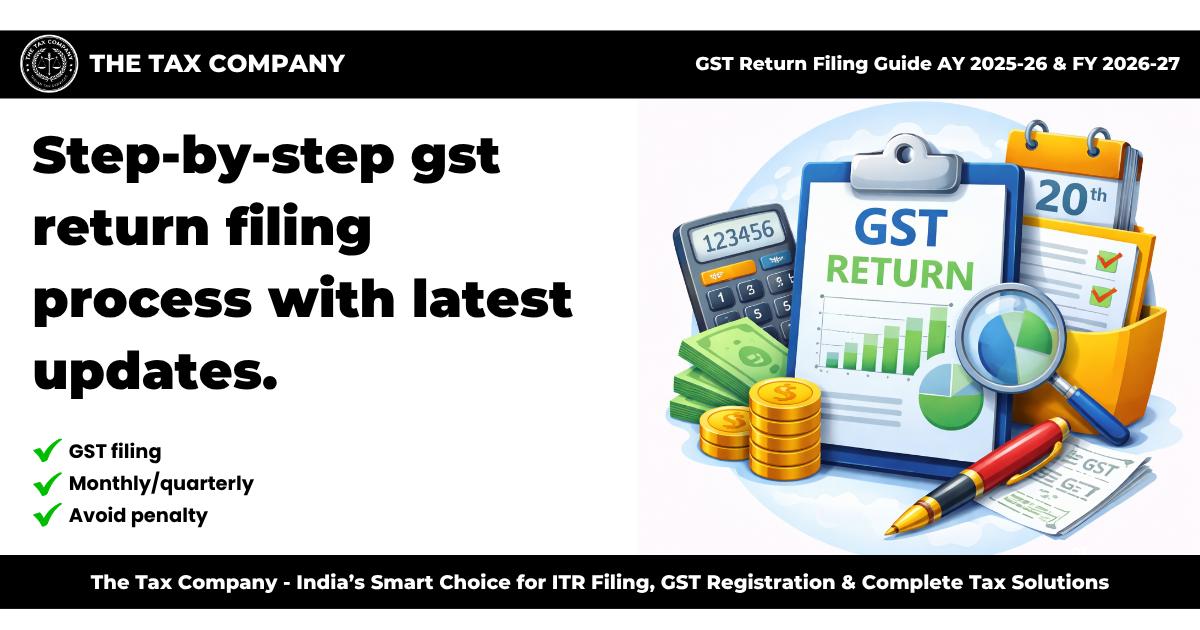
GST Return Filing Guide AY 2025-26 & FY 2026-27
Introduction
Goods and Services Tax (GST) return filing is a mandatory compliance requirement for all registered taxpayers in India. It involves reporting details of sales, purchases, tax collected, and tax paid to the government.
For Assessment Year (AY) 2025-26 and Financial Year (FY) 2026-27, timely and accurate GST return filing is essential to avoid penalties and ensure smooth business operations.
This guide provides a complete overview of GST return filing.
What is GST Return Filing?
GST return filing is the process of submitting details of business transactions to the GST portal.
It includes information about outward supplies, inward supplies, input tax credit (ITC), and tax liability.
Who is Required to File GST Returns?
GST return filing is mandatory for:
- Businesses registered under GST
- E-commerce operators
- Service providers
- Manufacturers and traders
Types of GST Returns
- GSTR-1: Details of outward supplies
- GSTR-3B: Summary return of tax liability
- GSTR-4: For composition scheme taxpayers
- GSTR-9: Annual return
Due Dates for GST Return Filing
- GSTR-1: Monthly or quarterly (based on turnover)
- GSTR-3B: Monthly
- GSTR-4: Annually (for composition taxpayers)
- GSTR-9: Annually
Due dates may vary as per government notifications.
Documents Required for Filing
- Sales and purchase invoices
- Debit and credit notes
- Bank statements
- Input tax credit details
- E-way bills (if applicable)
Step-by-Step GST Return Filing Process
Step 1: Record Transactions
- Maintain all sales and purchase details
Step 2: Prepare GST Data
- Compile invoice-wise information
Step 3: Reconcile ITC
- Match ITC with GSTR-2B
Step 4: Calculate Tax Liability
- Determine payable GST after ITC adjustment
Step 5: File GST Returns
- Submit GSTR-1 and GSTR-3B
Step 6: Pay GST Liability
- Pay taxes within due date
Input Tax Credit (ITC) Management
- Claim ITC on eligible purchases
- Verify supplier compliance
- Avoid ineligible ITC claims
- Reconcile ITC regularly
Penalty for Late Filing
Failure to file returns may result in:
- Late fees per day of delay
- Interest on unpaid tax
- Suspension or cancellation of GST registration
Common Mistakes to Avoid
- Missing filing deadlines
- Incorrect GST calculations
- Wrong ITC claims
- Mismatch between GSTR-1 and GSTR-3B
- Incomplete documentation
Tips for Smooth GST Filing
- Maintain accurate records
- Reconcile data regularly
- File returns on time
- Stay updated with GST rules
Benefits of Timely GST Filing
- Avoid penalties and interest
- Ensure legal compliance
- Maintain business credibility
- Smooth business operations
Role of Professional Assistance
Professional assistance can help:
- Ensure accurate GST filing
- Manage ITC efficiently
- Avoid errors and penalties
- Provide compliance support
Conclusion
GST return filing is a crucial compliance requirement for businesses. Proper and timely filing ensures smooth operations and avoids legal complications.
For AY 2025-26 and FY 2026-27, businesses should prioritize accurate reporting and timely submission of GST returns.
Need Help with GST Return Filing?
The Tax Company (TTC) provides expert GST return filing services. Our team ensures accurate reporting and timely compliance.
Contact us today for professional assistance.