FSSAI Food License Registration Guide AY 2025-26 & FY 2026-27
Introduction
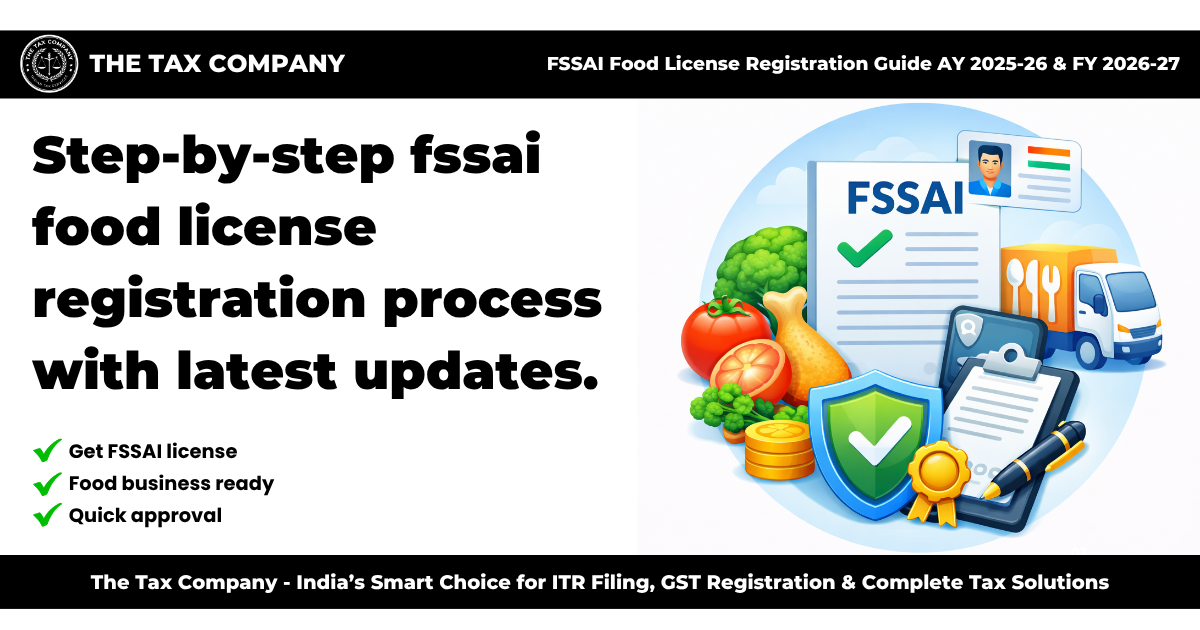
Starting or running a food business in India requires compliance with food safety regulations. One of the key requirements is obtaining an FSSAI Food License, issued by the Food Safety and Standards Authority of India.
For Assessment Year (AY) 2025-26 and Financial Year (FY) 2026-27, food business operators must ensure proper registration or licensing to operate legally and maintain food safety standards.
This guide explains eligibility, types of licenses, documentation, and the registration process.
What is FSSAI Registration?
FSSAI registration is a mandatory certification issued to food businesses to ensure that they comply with food safety and hygiene standards.
It provides a 14-digit registration or license number that must be displayed on food packages and premises.
Types of FSSAI Registration / License
- Basic Registration: For small businesses with turnover up to Rs. 12 lakh
- State License: For medium businesses with turnover between Rs. 12 lakh and Rs. 20 crore
- Central License: For large businesses with turnover above Rs. 20 crore or involved in import/export
Who Requires FSSAI Registration?
FSSAI registration is required for:
- Restaurants, cafes, and food stalls
- Home-based food businesses
- Food manufacturers and processors
- Distributors and retailers
- Online food sellers and cloud kitchens
- Importers and exporters of food products
Documents Required for FSSAI Registration
The following documents are generally required:
- PAN card of applicant or business
- Identity proof (Aadhaar, voter ID, etc.)
- Address proof of business premises
- Business registration certificate (if applicable)
- Food safety management plan
- List of food products to be handled
Step-by-Step Registration Process
Step 1: Determine License Type
- Identify whether Basic, State, or Central license is applicable
Step 2: Visit FSSAI Portal (FoSCoS)
- Access the official registration portal
Step 3: Fill Application Form
- Form A for Basic Registration
- Form B for State and Central License
Step 4: Upload Documents
- Submit required documents
Step 5: Pay Fees
- Pay applicable government fees
Step 6: Inspection (if applicable)
- Authority may inspect premises
Step 7: License Issuance
- Certificate is issued after approval
Validity of FSSAI License
- Valid for 1 to 5 years
- Renewal required before expiry
Penalty for Non-Compliance
Operating without FSSAI registration may result in:
- Penalty up to Rs. 5 lakh
- Imprisonment in serious cases
- Closure of business operations
Benefits of FSSAI Registration
- Legal authorization to operate
- Builds customer trust
- Ensures food safety compliance
- Required for listing on food delivery platforms
- Helps in business expansion
Common Mistakes to Avoid
- Choosing incorrect license category
- Submitting incomplete documents
- Not renewing license on time
- Ignoring hygiene standards
- Providing incorrect business details
Tips for Smooth Registration
- Ensure accurate documentation
- Select correct license based on turnover
- Maintain hygiene and compliance standards
- Apply for renewal in advance
Role of Professional Assistance
Professional assistance can help:
- Identify correct license type
- Ensure accurate filing
- Handle documentation and compliance
- Avoid delays and rejection
Conclusion
FSSAI registration is essential for any food business to operate legally and maintain consumer trust. Proper registration ensures compliance with food safety laws and supports business growth.
For AY 2025-26 and FY 2026-27, businesses should complete registration and renewal on time to avoid penalties.
Need Help with FSSAI Registration?
The Tax Company (TTC) provides expert assistance in FSSAI registration and licensing. Our team ensures accurate documentation and smooth processing.
Contact us today for professional support.